GUI-HARVEST
Self-improving GUI agents · Under review at ICLR 2027 · arXiv preprint
 HF Paper
GUI-HARVEST enables a frozen GUI agent to improve its own executable runtime harness from repeated multimodal executions, without updating the backbone model’s weights.
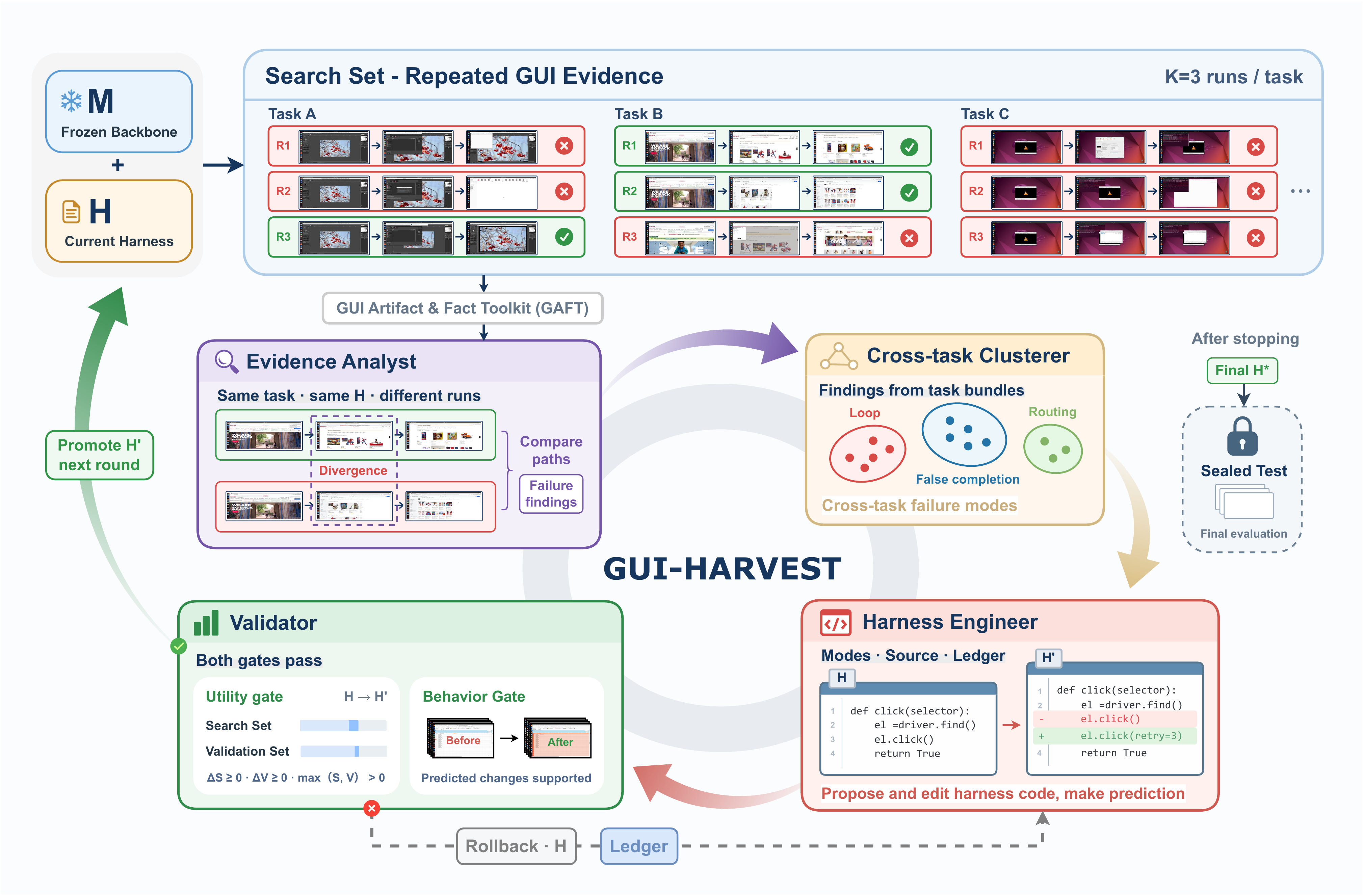
Why GUI harness evolution is different
A GUI harness controls how observations are assembled, actions are executed, and verification, recovery, and termination are handled. Optimizing it requires more than reading textual traces: the system must reconcile model intent with visible interface changes, diagnose failures despite run-to-run execution variability, and turn task-local evidence into reusable runtime changes.
Evidence-driven self-improvement
GUI-HARVEST aligns model outputs and executed actions with before-and-after screenshots, then compares repeated runs of each task as a joint evidence unit. Verified findings are consolidated into recurring cross-task failure patterns. A Harness Engineer maps those patterns to bounded source-code edits and records predicted behavioral effects before evaluation; a Validator promotes an edit only when repeated executions pass both score and behavior checks.
Results and transfer
On OSWorld-Verified, GUI-HARVEST produces consistent held-out gains across six general-purpose open, GUI-specialized open, and proprietary backbones. With Qwen3-VL-32B-Instruct at a 15-step budget, the full-suite score rises from 38.61% to 50.94% (+12.33 points). The frozen OSWorld-derived harness also transfers to WindowsAgentArena without further optimization, improving GPT-5 from 50.88% to 64.75% (+13.87 points) at 50 steps.
The contribution is not a single hand-designed harness. It is an evidence-driven optimization procedure that lets frozen GUI agents convert their own repeated executions into validated, reusable runtime improvements.